Showing posts with label winter. Show all posts

Saturday, 26 January 2013

Winter fun-time

Depending on where you're living, you may have been a bit cold this week. Much of Canada, Britain, the US, and Europe have been much colder than usual.

Where I'm living, that meant temperatures going down to lows of -40*C with wind chill. To put that into perspective, have a look at this video. It's so cold that boiling water instantly freezes upon contact with air. It's cold.

So to put it mildly, I've been staying inside.

The upside of this cold weather, however, is that Ottawa's famous Rideau Canal skateway fully opened yesterday, and the conditions are fantastic.

If you're not familiar with the Rideau Canal, it's original purpose was to connect Ottawa and Kingston, to facilitate communications and movement of troops between the old and new Canadian capitals. To say the least, it no longer serves this purpose. Instead, every autumn the canal water is drained to a lower level, carefully monitored until it freezes, then opens as the "world's large skating rink", with a length of 7.8 kilometers, and a size equivalent of about 90 Olympic ice hockey rinks (all numbers taken from Wikipedia).

The canal is incredibly well maintained, and posts regular updates about ice conditions. It has food stalls, rest areas, roving paramedics, skate rentals, and heated changing chalets.

And the best part? It's COMPLETELY free to the public (skate rentals and food aside)!

I was so happy this morning when I woke up and checked the weather forecast (about -20, so pretty reasonable), and ice conditions (good!). I packed up my thermos of hot chocolate, a pack lunch, and my skates, and headed off to the canal.

 This is the first time I've been on the canal for over 6 years, and it felt really good to be back! There's something lovely about skating along on a frozen body of water, surrounded by children just learning to skate, families taking their sick relative out for a day (you can rent sleds or bring your own), people using all types of skates, from figure skates, to speed skates, to hockey skates, to sledges.

 The most important things to remember when you're skating on the Rideau Canal are:

- bring a back-pack to carry your boots, food, etc, and any layers you might want to remove
- bring water!
- bring extra layers, just in case
- have fun!


Got my skates on and I'm ready to go!


I paid a quick visit to my former primary school. A yearly school activity was always a night-time scavenger hunt on the canal. Fun for the whole family (except my mum, who couldn't skate... but that's ok! You can walk on the canal too!)


There are these little rest-stops along the way, where you can get hot drinks, beaver tails, and other snacks. Or just have a little rest! I needed to sit down at this point because I had tied my skates too tight. Muscle pain and shin splints ensued. So I stopped, let my muscles relax, then re-tied my skates a bit looser. (In this photo, you can also see a child-carrier - these are normally pulled behind bicycles, but are really handy to push your kids or your stuff on the ice, too!)
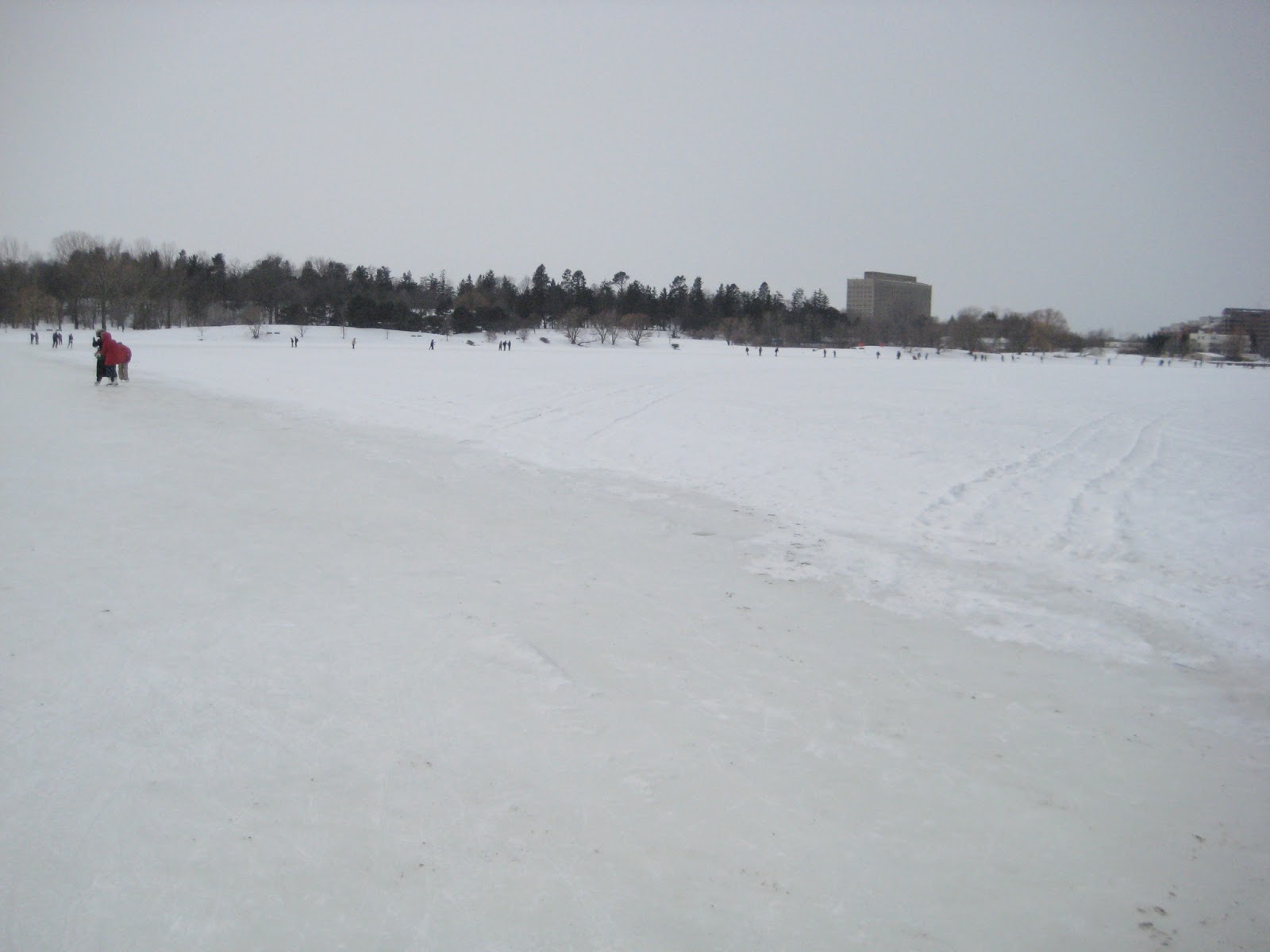


After about an hour, I reached Dow's lake - just about the furthest edge of the canal. This is where I had my lunch and turned around. It's about 5km away from where I started.


Lunch time! A thermos full of hot chocolate, a peanut butter sandwich, an orange in slices, and a piece of Christmas cake. This was my little way of trying to defeat the urge to have a BeaverTail. It worked, but mostly because I didn't have enough cash for one.


After a half-hour skate, I was back again! (I tied my skates properly this time, so no need to pause to ease my muscles). Tired, sore, but happy :)


One of the reasons I wanted to post this is because, for me, it's proof that you don't need a gym membership to be physically active. Ottawa is a fantastic place for outdoor physical exercise. In the winter there's the canal, but in the summer there's an incredible network of dedicated bike paths, and lots of open areas. These outdoor spaces are my gym, no membership required!

What outdoor activities are available in your area? Do you take advantage of them?

Sunday, 4 November 2012

Tip #10 - Keeping Warm

This tip is based on a suggestion from my friend Meghan, who pointed out that, with the cold weather approaching, a higher proportion of our money will be spent keeping warm. Here are some pointers on how to cut down the cost of toasty fingers.

Keep your heating equipment functioning well

Make sure your boiler or heater gets a check-up early. Like, now. It will decrease your headache if it goes on the fritz in January. This has to be done by a qualified professional, but in order to make sure the boiler isn't working overtime for nothing, you need to make sure your radiators are free of dust. Before you turn them on for the first time, run a dusting cloth attached to an unbent coat hanger between the heating panels of the radiator, making sure all the dust is gone.

If you have hot-water radiators, connected to a boiler, make sure the air is thoroughly bled from them. Do this by using either a wrench or a special radiator key to open the valve on the side of the radiators. Hold an old cloth or some paper towels against the valve to prevent any spillage when the air is removed. As an added bonus for this style of radiators, stick sheets of aluminium foil with blu-tak to the wall behind the radiators. This will propagate the heat out into the room, heating it faster and more effectively.

Know your energy plan

There are many energy plans out there, with different prices for different types of energy (gas, oil, and electricity). Know what your house or apartment uses for heating, cooking, and water heating (these can be different), and what your energy plan is charging you per unit. This information should be found on your energy bill. Use this information to compare to other energy suppliers. If you find a cheaper solution, phone up your own supplier and threaten to switch. Chances are, they want to keep a paying customer, and will put you on a cheaper plan if one is available.

Another tip for dealing with the energy suppliers is not to pay by direct debit. Although it may seem nice to have a single, flat rate each month to pay, and to have it leave your bank account worry-free, you could be paying too much. By paying through a per-usage, meter read system, you could not only save money, but you will be more conscious of your monthly usage, and therefore able to cut down on your usage in a conscious way.

Acknowledge your circumstances

If you need to heat your house, you're not living in a tropical country. There is therefore no reason why your house should be heated to 30*C. Lower the temperature and add a layer. You will save loads of money.

There are some other tricks of the cold-country trade which should be learned if you're new to this situation:
(1) take your shoes off at the door and switch to slippers or thick socks
(2) eat more complex carbohydrates (providing heat and energy for longer) and protein
(3) have a sofa-blanket so you can snuggle up warmly while watching TV or reading a book
(4) wear warm pyjamas and sleep under a duvet (better than blankets!)
(5) turn the heating down at night and when you're not in the house - you need it to be warm enough to not have pipes freeze (minimum inside temperature of about 16*C) - but it needn't be blasting heat when you're not going to enjoy it
(6) get any door and window leaks seen to and plugged, before the cold weather really starts. Nothing kills your buzz like a draft.

Recognize other areas your energy cost is going

Cooking, showering, and using hot water cycles on washing machines and dishwashers also contribute to your monthly energy costs. Cutting down on these is a hidden way to cut your expenditures.

Cooking: as above, with changing the type of food you eat, you should also think about the method of preparation. Use a kettle to boil water; Use more one-pot recipes such as home-made soup, stir-fry, or curry, making sure you use a good thick-bottomed pot; If you have one, use a Crockpot, which can cut down on energy costs dramatically. Make more than you need, freeze it, and re-heat in a microwave.

Showers: it's no secret that hot water uses energy, but in winter a hot shower can be incredibly enticing. If you want to save money, buy a cheap water-proof timer and time your showers. Aim to reduce them by 10 seconds each shower until you reach a point where you feel you couldn't take any more time off and still come out clean (and shaven). I usually have my showers at night, allowing my body to cool down ready for sleep and reducing the need for hair drying equipment.

Washing clothes and dishes: some countries offer discounts to households which run large appliances only at night. If you have a washing machine or dishwasher equipped with a timer function, and these discounts are available in your area, take advantage! Just make sure you empty it in the morning. Also, make sure you have a full load each time you use one of these machines, and use the cold water cycle of washing machines. If you're running your dishwasher during the day, open it before the heat dry cycle begins. Your dishes will still dry, they will just take a bit extra time and won't be warm.

And the final and most important tip: dress warmly, inside and out...

... because being blue isn't sexy.